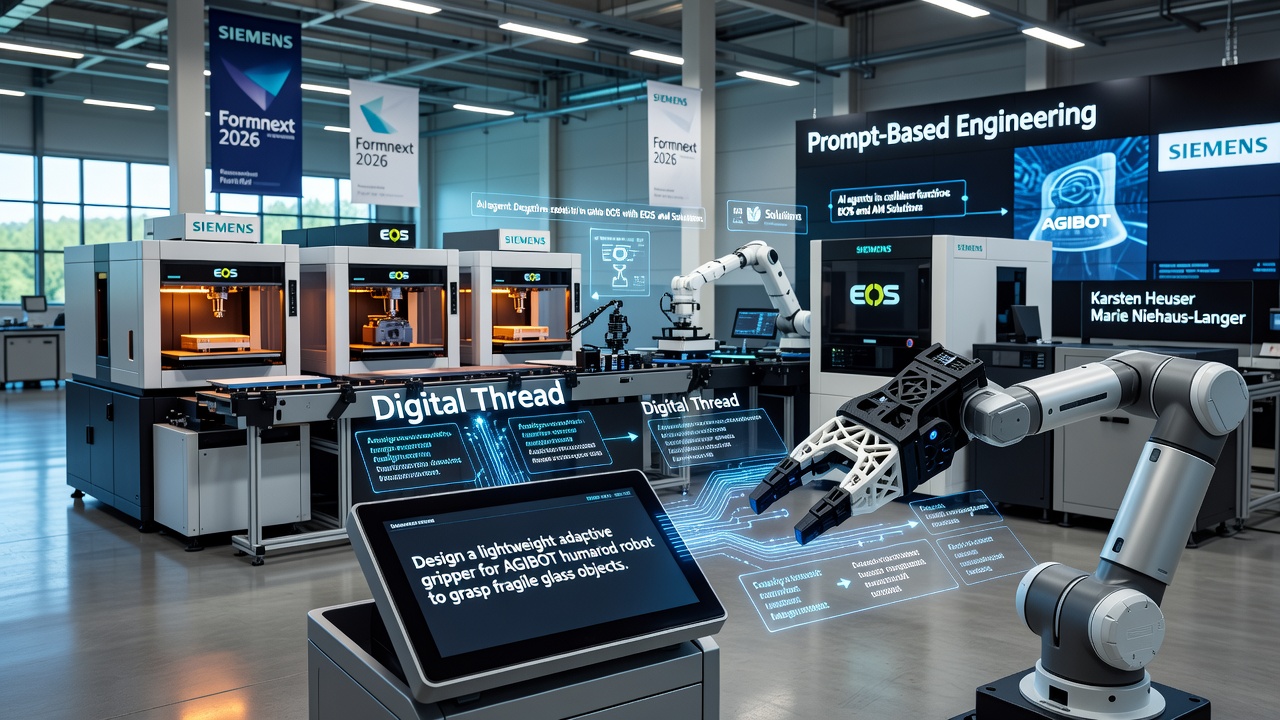
Siemens is building a software system that lets engineers describe a part in plain language and have artificial intelligence handle much of the design, simulation and manufacturing prep work for 3D-printed components. The company demonstrated the concept with a humanoid robot gripper developed alongside AGIBOT, and it plans to extend the same philosophy from engineering into the factory floor through a new production cell built with EOS and AM Solutions in Erlangen, Germany.
From typed description to printable part
Instead of manually reshaping a robotic gripper for every new object it needs to handle, an engineer using Siemens' system describes the item and the task at hand. An "agentic" AI workflow then takes over a sequence of engineering steps: selecting an appropriate gripper type, adjusting its geometry inside Siemens' Designcenter software, running simulations, and checking that it fits and functions correctly with the robot's interface. The AI agent reaches into the engineering tools themselves through a connection method called MCP integration, letting it trigger functions and move through each stage without a person operating every program individually. Once validated, the workflow formats the design data for additive manufacturing, commonly known as 3D printing.
Siemens describes this as a shift toward "prompt-based engineering," where natural-language input replaces some manual CAD work. Karsten Heuser, the company's Vice President of Additive Manufacturing, said industrial AI "fundamentally changing how we develop and manufacture products" by letting agentic workflows orchestrate tasks based on specific requirements rather than requiring engineers to build each variant by hand.
Extending automation into the factory
Designing a custom part faster only solves half the problem if production can't keep pace with the resulting variety. To address that, Siemens is working with EOS and AM Solutions to create what it calls an adaptive production cell at its electronics factory in Erlangen. The aim is a connected chain of 3D printing hardware, automation and software that can handle different components and process requirements without manual reconfiguration for each job, while still producing consistent, repeatable results suitable for industrial use.
EOS CEO Marie Niehaus-Langer framed the effort as part of a broader industry shift "from connected and automated factories to intelligent, adaptive manufacturing," and said the partnership is meant to support what she called an independent European approach to manufacturing technology.
Data continuity and limits
Siemens says the entire approach depends on an unbroken "Digital Thread" - a continuous flow of data linking design, simulation, manufacturing preparation and production so that AI tools can act on consistent information at every stage. The company notes that quality control, traceability, security and human oversight remain essential requirements before such AI-driven workflows can be deployed at industrial scale, meaning the technology is positioned as an aid to engineers rather than a fully autonomous replacement for human review.
Siemens also offers a planning tool called the AM I Navigator, now updated to include industrial AI features, to help manufacturers identify where these capabilities might be useful in their own design or production processes and to plan pilot projects accordingly. The company says it will show the humanoid gripper workflow publicly at the Formnext 2026 trade fair in Frankfurt, Germany.